what strategies can one use to walk away but not talk back
Do yous continually have to stop your lessons due to a group of off-task students?
Are you frustrated considering you're losing besides much class fourth dimension to addressing disruptions?
Here are eight ways to redirect off-task behavior without interrupting your lesson or allowing your unabridged lesson to be derailed.
ane. Utilize fewer words and less emotion.
Information technology's like shooting fish in a barrel to drift into lengthy lecturing, nagging, and yelling questions nosotros don't want to hear the answers to. So, train yourself to start using a handful of phrases that are brusk and to the point. I like:
- I need you lot to __.
- Please ___.
- Allow'due south stay focused.
- I don't like that.
- Non appropriate.
- Stay with us.
For the first redirection to the class or an private educatee, I usually go along it light. I'll say, "Stay with united states" with an encouraging grin that communicates: This is going to be expert–don't miss out!
For the second redirection, I'll say, "I need you to follow along" with broad eyes, raised eyebrows, and nodding to communicate: You lot're going to work with me hither, people, right? Come on, you lot tin can exercise this!
For the third redirection, I'll give a cold stare and a blank, expressionless face up, and say in a monotone vocalization, "Not appropriate. We're reading the text right now" to communicate: This behavior is non okay, and yous know it.
It'due south of import non to show anger, as that often escalates or feeds disruptive beliefs and will immediately get the attention of students who were engaged only at present desire to watch the drama unfold. Don't friction match the intensity of students' beliefs: tone yourself downwards, which encourages them to tone down. Showing quiet disappointment or disapproval in your facial expression and tone is enough to communicate a strong bulletin without distracting the students who are on-task.
2. Teach kids specific non-verbal directives, like manus signals or sign language.
Bear witness your students the signs for delight, cheers, sit down, tranquillity, stand upward, line up, yes, no, etc. This mode, you can give reminders and directives without having to stop your lesson, repeat yourself, or nag.
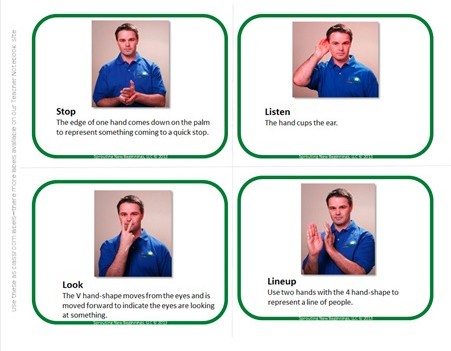
You can also work with specific students to create individual hand signals. For example, a student might desire to have a hand signal she or he can give you to bespeak, "I'1000 getting really frustrated and need a break" and you might want a signal that says, "You lot're doing __ again and y'all're supposed to ___, retrieve?" These hand signals are generally meaningless to the residuum of the class–if anyone asks, just say, "That'south a special sign between me and her. She knows what it means."
three. Stand near the off-task kids but continue eye contact with the on-task kids.
As you're teaching, walk over to where the off-task behavior is occurring. Don't wait at the kids who are existence confusing or acknowledge them, as that will shift the gaze of the rest of the class, too. Keep looking at and talking to the kids who are on-task; just stand closer to the students who are off-chore.
If a kid doesn't get the hint, rest your hand on the edge of his or her desk while you go on to teach. When the student gets quiet again, walk away without ever making eye contact or acknowledging the misbehavior. This works very well with nigh xc% of students, in my feel. If needed, lean down and whisper a curt instruction ( "I need yous to ___") and so walk away. Don't wait for the child to end acting out, because that can turn into a power struggle. Say information technology with confidence, and and then walk abroad so the kid has a few moments to self-correct.
4. Pair up a 3 second freeze with The Teacher Look.
Once you've established a potent rapport with kids, you lot can be confident the ice common cold stare (aka the "Are you kidding me?" look) will stop nearly misbehavior immediately. Generally, kids who truly like and respect their teachers don't want to be on the receiving cease of the teacher'south disapproval.
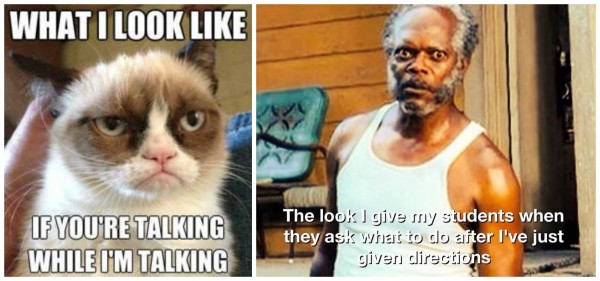
My teacher look is a cantankerous betwixt these two, depending on how obnoxious the off-task behavior is.
I've heard many teachers say that The Teacher Look doesn't work for them, because the kids who need to meet it aren't looking at the teacher. Here's what you do: during your lesson, end yourself dramatically mid-judgement and freeze/glare, similar this:
[Talk to the form in a normal voice and look at the students who are on-task] "And so, I want to hear your thoughts on…[speedily cutting your optics over to the kids having side conversations; freeze and glare at them for 3 seconds in dead silence, then wait dorsum at the on-chore students]…the different strategies your group shared just now. Heighten your hand if…"
Then proceed on with the lesson equally normal. The off-chore students will unremarkably find that the room all of a sudden fell silent, and you lot don't have to interrupt the residual of the class' train of thought by maxim a word. If the engaged students are furiously taking notes or otherwise involved in the activity, they often won't fifty-fifty discover the freeze/look.
When the off-task beliefs is really confusing and distracting the whole grade, the freeze/wait is very effective at non only letting the kids who are off-job know that you discover what they're doing, merely too letting rest of the course know you're aware of the misbehavior and y'all're not going to tolerate information technology. If the kids don't go back on-chore, you don't take to cease your whole lesson. You can go along right on teaching without fear of losing respect of the rest of the course, because you have best-selling the trouble. Then you can…
5. Create a natural interruption in the lesson to talk privately with students who are beingness disruptive.
Ask the class to practice a quick pair/share, turn-and-talk, quick guided practice activity, or solve a sample problem independently. Then use that moment to quietly walk over to the kids who are misbehaving. You tin give a quick correction (one of your get-to phrases from strategy #1, perhaps) or talk with them about their choices.
6. Ask elementary questions that prompt students to self-right.
Attempt request questions that require the child to remember nigh what she or he is doing and assist the child determine a more than appropriate behavior. This strategy works well because y'all don't have to give control to kids which they might and then rebel confronting, and y'all don't force them into a position where they have to give in because they were never told what to do.
What should you exist doing right now? is my absolute favorite question for promoting self-correction, and it works in just about whatsoever situation. You lot can also try replacing your teacher-direct commands with problem-solving prompts, similar this:
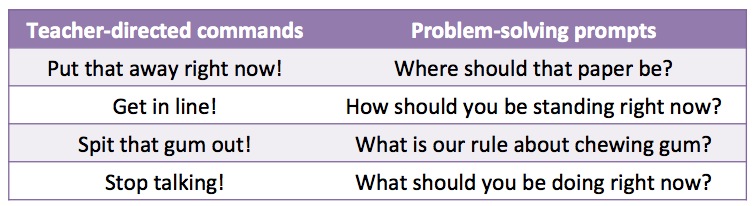
Usually when I enquire these types of questions, students will pause, call back, and so cocky-correct without any issues. They're effective because students determine the solution and cull a unlike behavior, and instead of wearing united states of america both down with more nagging, I go to say something positive and encouraging after ("Thank yous" or "That'south exactly right.")
7. Involve students in the lesson to appoint, non embarrass.
It'south great to phone call on off-chore students during a lesson, but but for the purpose of drawing them back into the lesson, not for shaming them for not following along. If you enquire a question you lot know the student won't be able to reply, that does cipher to keep up the lesson momentum or help the kid successfully participate. It creates frustration for everyone involved when the entire course is staring impatiently at someone who has no idea what's going on.

Instead, say, "[Off-task student], I'chiliad going to call on y'all in one minute to demonstrate how to solve #4. [On-chore educatee], would yous solve #3 for united states right now?" That gives the educatee a gamble to prepare and also figure out what'southward going on earlier existence put on the spot.
Yous can also draw the off-chore pupil into the activity through a task that doesn't crave him or her to have been paying attending. It could be every bit simple as: "___, what color highlighter should I use to marker our sight words here?" That gives the child some buying over what'southward happening in the lesson and allows him or her to begin participating again. Y'all tin besides ask the off-job student to concur the book up as you read, pass out materials, come up to the board and have notes for the grade every bit you explain something, so on.
8. Provide support until the students experience success.
Sometimes your attempts to appoint kids in the lesson work only for infinitesimal or 2. If you see that a student is getting off-task over again right later on a subtle redirection or try to engage, y'all may need to be more persistent.
Don't lecture or nag, just walk over to the off-task students and say, "So we're discussing #8 right now with partners. Can you two share how you got your answers?" Stay at that place for a few moments to make sure the students understand what they need to exist doing and are experiencing success. Give a compliment before you lot walk away to end the exchange on a positive note: "I knew you could exercise it!" "That'south exactly correct, thank you" or "That's it–continue it up."
Those are some strategies that have worked for me. How do you redirect students who are off-task without interrupting your lesson?
Source: https://truthforteachers.com/8-ways-to-redirect-off-task-behavior-without-stopping-your-lesson/
0 Response to "what strategies can one use to walk away but not talk back"
Post a Comment