Kramer E 2002 On Quality in Art and Art Therapy American Journal of Art Therapy 40 218222
Keywords
Art therapy; Psychological, Psychosocial; Literature; Sculpture; Self-expression
Introduction
Art therapy is a class of projective technique that uses the creative process of art making to amend and enhance the physical, mental and emotional well-existence of individuals of all ages. It is based on the belief that the creative process involved in artistic self-expression helps people to resolve conflicts and problems, develop interpersonal skills, manage beliefs, reduce stress, increase cocky-esteem and self-awareness, and achieve insight. Art therapy integrates the fields of human development, visual art (drawing, painting, sculpture, and other art forms), and the creative process with models of counseling and psychotherapy. Co-ordinate to British Clan of Art Therapists, "Fine art therapy is a form of psychotherapy that uses art media as its principal mode of communication [1]. It is practiced by qualified, registered Art Therapists who work with children, young people, adults and the elderly. Clients who can use art therapy may have a wide range of difficulties, disabilities or diagnoses. These include, for example, emotional, behavioral or mental health problems, learning or physical disabilities, life-limiting conditions, encephalon-injury or neurological conditions and physical affliction. Art therapy may exist provided for groups, or for individuals, depending on clients' needs. It is non a recreational activity or an art lesson, although the sessions tin can exist enjoyable. Clients do non need to have whatsoever previous experience or expertise in fine art".
Kramer was the first person to champion this school of thought [2]. Kramer emphasized the healing qualities of art making, and was concerned with artistic quality. Art therapy too helps people to discover things nigh themselves based on what they draw. Forth with Fine art therapy, it is necessary to counsel children and so that they are able to overcome their issues & fears. Art therapy & counseling can together assistance a kid in enhancing their capacity to deal with problems and would eventually atomic number 82 to their optimal development. Naumburg believed that this was the best way to utilise art therapy [3]. In this manner, the art therapist uses fine art as a window into the subconscious of the patient, and from there tin can attempt to figure out the underlying issues that the patient may be suffering from. Information technology can be risky to look into art also closely, but in the case of children, who may non have the words to express how they are feeling; it is very beneficial to use art as a mode of expression. Two of the procedures warrant additional attending. The first i involves the use of art or drawing every bit an assessment tool, procedure clinicians have used for some time. The 2nd is the use of clinical interview with children, adolescents and parents.
Drawings or Fine art
Drawings or art can exist used in both standardized and nonstandardized assessment procedures. One standardized procedure is the Good enough-Harris Dearing Test [4]. This test requires children and adolescents to make a motion-picture show of a human or woman and a film of themselves. Another commonly used standardized test is the House-Tree-Person in which children and adolescents first draw a house, then a tree and last a person [5]. Almost recently, Knoff and Prout developed the Kinetic Drawing System for family and Schoolhouse, Children and boyish, describe ane picture show of their family unit and another that relates to schoolhouse [6].
This examination assesses important human relationship at home and school. Stabler provides data on the non-standardized use of drawings with children and adolescents. He notes that drawings can be us to obtain an estimate of a child or adolescent'southward cognitive and psychosocial evolution and level of maturity [7].
Purpose of the Written report
The purpose of this research was to assess on how art therapy could bear witness to be useful in combating the mental illnesses that are prevalent in higher institutions. This research is important because stress and feet touch the lives of many students and tin can have strong influences on students psychologically, emotionally, physically and academically. It is important for counselors to acquire how they can better assistance students and to build coping mechanisms and resiliency. Art therapy could be constructive as it is proven to be a good tool when working with mental wellness issues. It is also a versatile approach and is price and fourth dimension constructive. The present research was planned to study the impact of Art therapy and Counseling on adolescents undergoing stress and anxiety and help them to deal finer with their problem and issues through art therapy and counseling. It too aimed to help adolescents release their tension with the help of training in muscle relaxation technique.
Sample
Client 'A' was purposely selected for the purpose of the study. A case study method was adopted to focus on in-depth analysis of an individual. The assessment involved private who received services at the university counseling eye. Participation in the assessment was voluntary and anonymous. The participant used the counseling services and was about 18 twelvemonth's quondam female person, studying in form twelfth.
Materials
Participant was given a survey to mensurate the need and desire of art therapy in the counseling center. The needs cess is entitled "Using Fine art Therapy to Limited Your Self" and used a aye, no, or not applicable mensurate. There was also a department for comments to allow participant to express her thoughts on fine art therapy. The needs assessment test was developed past the researcher.
Process
An orientation talk was conducted for the participant to make her aware almost the objectives of intervention program, its bear on and benefits to the individual. The purpose of Art Therapy and Counseling was explained to the participant and was briefed virtually the procedure Fine art Therapy and Counseling to aware almost the concept of stress and anxiety and its related issues. Pre-stress feet test questionnaire was administered on the participant and was encouraged to undergo fine art therapy and counseling to overcome her problems and problems. She was also informed near ethical considerations involved in this process and assurance was given to them regarding confidentiality of their data.
Collection of Data
The information was collected through both quantitative and qualitative tools. The scores of pre and post stress and anxiety test questionnaire served as quantitative information whereas observation of adolescents and assay of their art work served equally qualitative data.
Pilot Study Data Analysis
The information analysis of pilot study was done through comparing the pre and mail stress score of the participant and inferences were made on the basis of stress score and artwork of participant. It was observed that art therapy and counseling had a significant impact on participant as it reduced the stress and feet level of participant.
Summary of the Case Analysis
The research was conducted to assess the effectiveness of Art therapy and Counseling on participant undergoing stress and feet. The obtained data has been analyzed by assessing the drawings fabricated by the participant and pre & post stress test questionnaire filled past her. The case summary wise data was as follows: (For maintaining the confidentiality of adolescents, their names take been changed).
Behavioral Observation
Client A was an eighteen year erstwhile girl studying in class XII in ABC school, Allahabad came to the counselor in realm of personal social counseling. She belongs to an upper eye course socio-economic background. Her family unit comprise of 5 members including her father, female parent, elder blood brother, grandmother and herself. Her father is a Chemic Engineer and mother is a housewife. She likes to listen to music and her favorite subject is English.
Client "A" mentioned that her mother does not go along well and has been diagnosed with depressive disorder. She stated that she thinks that she is suffering from Truman's syndrome. She feels that her friends are watching her through a camera all the fourth dimension and this makes her very conscious and thus she restricts herself in participating in various activities. She feels negativity all around and is unable to cope with life. She mentioned that she is very brusque tempered and her intense anger leads her to cut her mitt. She further stated that because of all these bug, she tried to commit suicide when she was in sixth standard.
Client "A" appeared to exist very stressed and sad when she came to the advisor. Her class teacher also referred her to the counselor.
Client A's pre-stress test questionnaire scores revealed that she has high stress (score 90). In view of the nature of the problem, art therapy and counseling were conducted on the customer to help her overcome her bug.
Fine art Therapy
The entire procedure of Art Therapy was divided into 4 parts:
1. Cess
two. Handling in the Outset
3. Mid-phase of handling
4. Termination
Assessment
The main objectives of Cess were:
• To build a psychological climate of warmth, credence, trust and empathy so that the client feels free to talk about her trouble.
• To gather data about client's family.
Consequence
Customer A was very restless when she came to the counselor but as the session progressed she felt comfortable. She reported that from the concluding v-half-dozen years she feels that her friends are ever watching her through a photographic camera. She mentioned that she thinks that this world is not made for her and therefore she has made an imaginary world for herself that consist of all those people who are shut to her and where only love & positivity exist. She discussed about her brusk-tempered behavior and mood swings. She mentioned when she gets upset she cuts her left hand and after cutting them she feels relaxed.
She further reported that she keeps very upset because of her mother'southward ill wellness. Her mother has been diagnosed with depressive disorder and as a event the surround at domicile is quite disturbing.
Researcher's Observation
Client "A" looked very shabby and was very restless to discuss her issues. She continuously fiddled with her finger while discussing her bug. And well-nigh of fourth dimension she was looking at the roof while talking.
In the next session of cess, the objectives were:
• To explore customer'southward relationship with her father and brother.
• To administrate pre stress test questionnaire on the client.
Effect
In this session, client A's human relationship with her begetter and brother was explored. She mentioned that she shares a adept relation with her father and said that he remains very upset because of her mother'due south health. She told that her brother does not stay with them because of academic reasons. After this, she was given the Stress exam questionnaire and was motivated to fill up it accurately.
Handling in the Kickoff
Objectives
• To orient the client virtually Fine art therapy.
• To teach relaxation technique to the customer.
Event
In this session, client A was oriented near Art Therapy and its features. She was quite amazed to hear about such a therapy and was initially hesitant to indulge in it. But, she was motivated and encouraged by telling her that this therapy does not focus on one's artistic accomplishment but rather self-expression of the individual.
After this, deep breathing relaxation technique was taught to client A and then that she can command her anger and increase her concentration.
Mid-phase of treatment
The main objectives of this phase were:
• To administer diverse techniques of Art therapy along with personal-social counseling sessions.
• To aid the customer save her tensions with the help of training in musculus relaxation.
Outcome and analysis
In this phase, several techniques of Art therapy were administered on the client, which was followed by Personal social counseling. The analyses of several techniques are as follows:
The client A undertook the following techniques one by ane:
Session 1: Automatic Drawing (also known equally the Scribble Technique)
In this, the client was asked to relax and brainstorm to make draw free lines or scribbles on paper. After a while the customer was instructed not to remove her pen from the paper until the exercise is over. Automatic drawing is an splendid way for the customer to let down their guards.
Upshot
In this task, client A initially made several lines and so made a 3-D face out of information technology. Information technology was very interesting to see how she made this face. When told to make a figure without removing the pencil, she fabricated a middle and a face. This activity was basically given to assist the customer A to remove her nervousness related to Art therapy and to make her more comfortable (Figure 1).
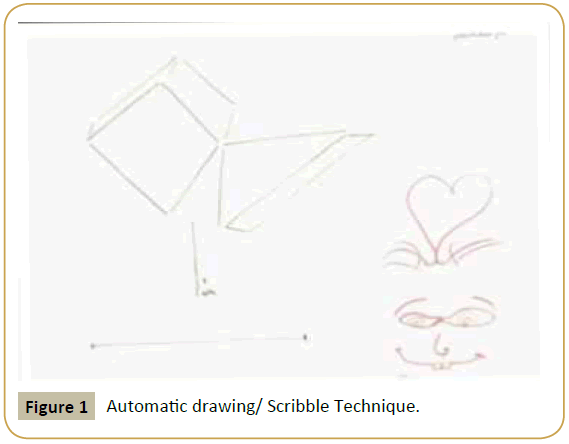
Figure 1: Automatic cartoon/ Scribble Technique.
Session 2: Free Drawing
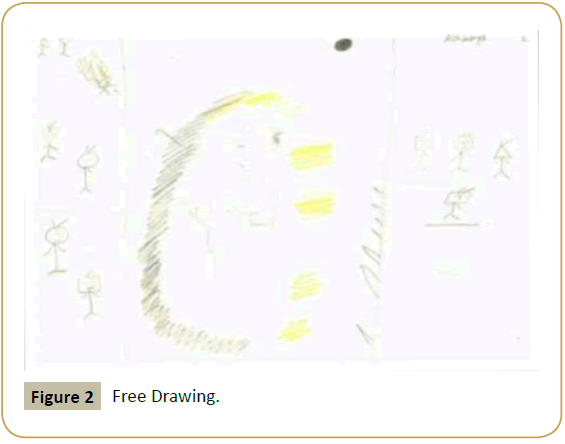
In this, the client "A" was motivated to express herself freely and not to worry nearly planning the drawing. This technique is very useful because the images that the client creates are often mirrors into the person's nowadays problems, strengths and weaknesses. At the end of the free mitt drawing, the customer was asked to share and explain what she drew near.
Outcome and Analysis
In this drawing, client A made her own self within a boundary. On the top of left paw side, she drew a camera from where she feels her friends watch her. Inside the boundary, she fabricated a blackness circle that depicts her imaginary world. She also portrayed positive and negative free energy which she feels she posses. She mentioned that her positive energy is declining whereas negative is increasing. She also made nails (symbol of pain) towards the right side of picture that she thinks are coming from her parent's side.
Client A mentioned that after drawing her issues, she could relate herself to her thoughts. She told that she felt very good and peaceful later making this drawing. This task gave an outlet to client A to portray her problems that she had not discussed before with anyone (Figure ii).
Effigy 2: Free Drawing.
Observation
Client A took lot of fourth dimension to make this drawing. She looked quite calm while cartoon.
Session iii: Iii Wishes
In the iii wishes technique, client A' was asked to portray her 3 or more wishes:
Consequence and assay
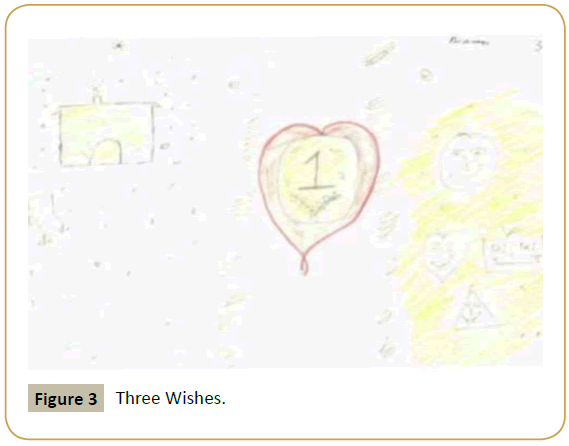
1st wish: In this drawing, she drew a firm which consists of a chimney. The snow is falling outside the business firm and the sun is shining vivid in the sky.
2nd wish: For the 2nd wish, she made 1 rupee coin encircled by a center.
3rd wish: In this drawing, she fabricated four grin faces.
Later client "A" completed the drawings, she was asked to explain what she drew so a give-and-take followed focusing on the strength of the wish and whether or not these wishes are attainable. While explaining the 1st wish, client "A" mentioned that she really wish to accept a house at a solitary place where snowfall e'er takes identify. She wants that her dream house should consist of antique pieces and a chimney to keep her house warm and cozy. The second wish of client "A" was that she should excel in whatever she does like sports, studies and so on. She wants that she should be very rich and famous. Her third wish is that her home environment should better and so that everybody is happy including her parents, brother, grandmother and herself.
After explaining her drawings, she was asked to tell which all wishes she recall are realistic and attainable. She stated that she thinks that her 1st wish is attainable but at a later phase. For iind wish, she is doubtful as it requires lot of hard piece of work and she does not like to put much effort for any task. She mentioned that her third wish is unattainable because of her mother's deteriorating health (Figure 3).
Effigy 3: Iii Wishes.
Observation
While explaining 1st wish, client A was very excited and happy. Only equally she came towards the final wish she seemed very upset and sad.
Session 4: Draw yourself equally an Animate being
In this task, client A was asked to draw herself equally any kind of animal, or as the animal she see herself as nigh similar to.
Issue and analysis
In this task, client A drew a Griffin. Client A mentioned that she drew Griffin considering it is a majestic animal and is loyal & trustworthy and she feels that she too has these qualities. Later this, the advisor asked customer A if she liked comparing herself to an animal. She mentioned that information technology was a great experience to first think and then draws an animal to which she thinks she resembles (Figure 4).
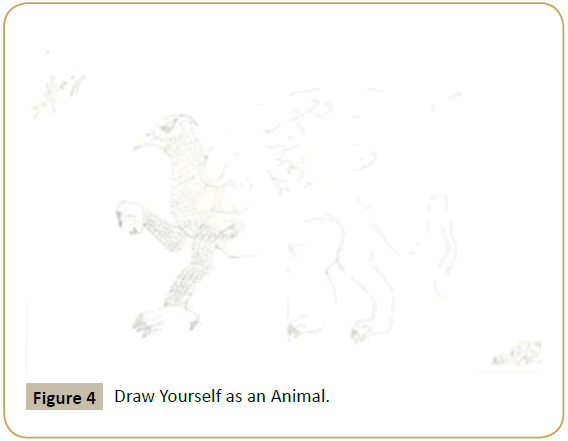
Figure 4: Draw Yourself as an Animal.
Observation
Client A took lot of fourth dimension to make this drawing. It seemed that she thoroughly enjoyed making this drawing.
Session 5: Progressive Muscle Relaxation Technique
The principal objective of this session was to aid client A salvage her tensions with the assistance of progressive muscle relaxation technique. The counselor instructed the client A to do progressive muscle relaxation in the post-obit fashion:
• Take a few minutes to relax, animate in and out in slow, deep breaths.
• When yous're relaxed and set up to start, shift your attention to your right foot. Have a moment to focus on the way it feels.
• Slowly tense the muscles in your right pes, squeezing as tightly as you can. Hold for a count of 10.
• Relax your correct foot. Focus on the tension flowing away and the way your pes feels as it becomes limp and loose.
• Stay in this relaxed state for a moment, breathing deeply and slowly.
• Now shift your attention to your left pes and squeeze it equally tightly as you tin can. Agree for a count of 10. Relax your left pes and focus on the tension flowing abroad and the mode your foot feels as it becomes limp and loose.
In the same way, instructions were given to relax legs, abdomen, back, cervix and face.
Effect
Customer A mentioned that she felt very fresh and relaxed subsequently undergoing this relaxation technique.
Session 6: Self-Portrait
In this technique, client "A" was asked to portray herself. This technique was aimed to help her gain complete awareness of her personal needs and torso prototype.
Outcome and analysis
In this drawing, client A portrayed her two different selves. In the first ane, she portrayed herself as existence very helpful and kind to people. In the 2nd picture, she portrayed herself as a short tempered person, who does non think before speaking and injure others.
While discussing nigh the drawing, client A mentioned that she feels that her bad quality is existence overpowering the expert one. She realized that she needs to command her anger to continue her cordial relationships with people around (Figure five).
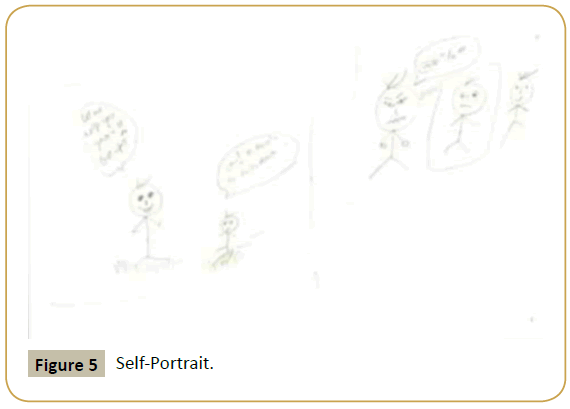
Figure 5: Self-Portrait.
Observation
Customer A seemed very enthusiastic while making the cartoon. She was frowning while making her short tempered flick.
Session 7: Cartoon Completion
In the drawing completion technique, customer A was given a piece of paper that already had few simple shapes on them. She was asked to use these shapes as a starting point and make a picture out of information technology.
Outcome and assay
From the first shape-circle, customer A fabricated a Lord's day along with tress, grass and birds. From the second shape she fabricated a blossom bud. From third, she drew her own self and a star. And from the terminal effigy she made a blackboard. When asked the reasons for making such shapes she mentioned that she fabricated Sunday considering she likes brilliant sunny days, she fabricated star because she want to get there, a bud because it is a symbol of freshness & calmness. Out of all these figures, she loved making a bud (Figure 6).
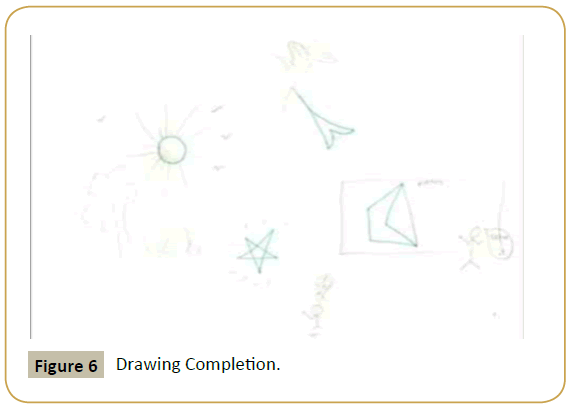
Figure 6: Drawing Completion.
Session 8: Firm-tree-person
In this task, the client was asked to depict a house, tree and a person in one motion-picture show. Subsequently completing the drawing, the client is faced with the task of relating the human figure to the other two common environmental features.
Event and analysis
In this task, client A made a firm consisting of a chimney, a tress correct outside the house with a bird's nest and a person walking towards the house.
When asked to explicate the cartoon, she mentioned that she wishes to have a small house at a identify where snow falls all the fourth dimension and where greenery is in that location. When asked to chronicle the person with the firm and tree, she stated that she has portrayed her best friend here and she wish that he should go along coming to her business firm. And equally far as the tree is concerned, she wants that birds should make their nest on information technology (Figure 7).

Figure 7: Firm-Tree-Person.
Observation
It seemed that client A enjoyed making this drawing. In this drawing she portrayed her aforementioned wish of having a small business firm as she did in Three Wishes Techniques task.
Termination
Objectives
• To talk over the outcomes of Art Therapy.
• To terminate counseling sessions.
• To administer post stress exam questionnaire on the client.
Outcome
The client came voluntarily for counseling with her irrational belief that she has Truman's syndrome. With the help of cognitive interventions the counselor was able to claiming her irrational beliefs. The customer was very stressed out when she came for counseling so earlier starting the therapy she was taught deep animate relaxation technique and so that she could cope with her stress in a better way.
Later on completing all the tasks of Art Therapy, customer A was asked how she felt afterward undergoing Fine art therapy & Counseling sessions. She stated that she was quite happy and content with the therapy & sessions. She told that she could never imagine that she would run across and so many changes in herself because of this therapy. 'A' mentioned that she feels that she know herself better now. She has realized that her acrimony causes lot of bug for her and other people and so she has now started controlling her anger with the help of anger management techniques. Most importantly, she mentioned that she no longer feel that someone is watching her through a camera. She feels free and happy now. After this, the advisor informed client A about successful completion of Art Therapy. She was informed well-nigh the termination of Fine art Therapy and counseling sessions and was encouraged to fill the mail service stress test questionnaire accurately. Customer A thanked the advisor for helping her resolve her problems and beliefs.
Evaluation
The customer came voluntarily for counseling with stress and anxiety. This case was a challenge for the counselor equally the client was very adamant that she has read about this type of trouble and knew that she is undergoing it. With the help of traditional art therapy the researcher was able to reduce her stress and anxiety. The customer was very stressed out when she came for counseling and then earlier starting the therapy she was taught deep breathing relaxation technique and so that she could cope with her stress in a better way. Fine art therapy seemed to be very helpful in this case. After portraying her thoughts on newspaper, the client realized that it was her irrational belief that people are watching her through a camera. She realized that in reality nothing similar this is happening. Individual counseling along with Art Therapy helped customer A to resolve her bug. Her post Stress test score indicate that she has below average stress (score 37). There are many case studies in the literature on the use of art therapy to reduce trauma symptoms and some proposals for fine art therapy treatment protocols for PTSD in children and adults [8-11]. Arnheim examined mental processes used in fine art making that art therapists believe may be involved in art therapy and discussed how visual perception corresponds to visual thinking [12]. Cognitive operations are not divorced from perception. Knowledge is built from the environment through the senses; the deed of perceiving things visually is directly tied to the way one thinks nearly them. Exploring, abstracting, and problem solving are all processes of higher level thinking that depend heavily on perception. Given art's reliance on perception and the senses, Arnheim postulated that art could be used to facilitate problem solving if it is truthful that visual perception is equivalent to visual thinking. The results of the present research point that art therapy would be beneficial to helping people limited their emotions; it would have a positive affect on individuals [12].
Limitations
Although from the results of this study 1 could infer that at that place is an overwhelming involvement and demand for art therapy, in that location were many limitations to the study. Showtime, the study was washed with simply i individual. In social club to generalize the results, a larger sample size would have been better.
Secondly, because the possibility of survey duplication by the same participant, a control for this must be met to business relationship for this.
Implications for Counseling Practice
This report provides a greater agreement for the need and interest in art therapy as an alternate approach to addressing mental health concerns. First, from the results, one can infer that student's are willing to back up the use of art therapy. Therefore, college counselors and students can recognize the usefulness of this time constructive method of counseling. The result of this study also informs counselors about the types of stressors that adolescents confront in today's society. With this noesis, counselors can better identify students experiencing excessive stress and tailor counseling interventions and art therapy to address the issues.
Recommendations for Further Study
In order to better establish the demand and interest of using art therapy as an additional approach, this study needs to be replicated with an increased number of participants, be screened for duplicate survey results and attach additional literature on the benefits of fine art therapy and mental health bug. This would allow one to sort out whether it is the lack of understanding and small population, rather than other factors like minimal information and a small-scale sample, that underlies to the percent of students who did not recommend or institute that this approach was not relatable. This implies that parents demand to exist constantly aware of the of import office that they play in nurturing of adolescent self-esteem.
Conclusion
The purpose of the present report was to examine on how art therapy could prove to be useful in combating the mental illnesses that are prevalent in higher institutions. From the results information technology appears that the demand and involvement for the apply of art therapy in a counseling center was supported. Thus, Art therapy is a form of projective technique that uses the artistic process of art making to improve and enhance the physical, mental and emotional well being of individuals of all ages. Information technology is based on the belief that the creative procedure involved in artistic self-expression helps people to resolve conflicts and problems, develop interpersonal skills, manage behavior, reduce stress, increase self-esteem and selfawareness, and achieve insight. Art therapy integrates the fields of human being development, visual art (cartoon, painting, sculpture, and other art forms), and the creative procedure with models of counseling and psychotherapy.
The study also found that well-nigh all the participants agreed with the treatment benefits of fine art therapy. An open up psycho-educational art group in the college setting could exist a useful approach to reducing depression and anxiety and providing students with coping skills.
References
- British Association of Art Therapists (2011) Code of ethics. London: Author.
- Kramer E (2002) on quality in art and fine art therapy. American Journal of Art Therapy 40: 218-222.
- Naumburg M (2001) Spontaneous art in education and psychotherapy. American Periodical of Art Therapy 40: 46-64.
- Harris DB (1963) Children's drawings as measures of intellectual maturity. New York: Harcourt, Brace & World, Inc.
- Buck J (1981) The HTP technique, a qualitative and quantitative scoring method. Journal of Clinical Psychology Monograph, Supplement 5: ane-120.
- Knoff HM, Prout HT (l985) Terminating students from professional psychology programs. Professional Psychology: Research and Practice 6: 789-797.
- Stabler JR, Johnson EE (1972) The significant of black and white to children, International Periodical of Symbology: 3.
- Rankin AB, Taucher LC (2003) A job-oriented approach to art therapy in trauma treatment. Art Therapy: Periodical of the American Art Therapy Association xx: 138-147.
- Raymer Yard, Mcintyre BB (1987) an fine art support group for bereaved children and adolescents. Fine art Therapy: Periodical of the American Art Therapy Association 4: 27-35.
- Sweig T (2000) Women healing women: Time-limited, psychoeducational group therapy for childhood sexual corruption survivors. Art Therapy: Journal of the American Fine art Therapy Association 17: 255-264.
- Collie Yard, Backos A, Malchiodi C, Spiegel D (2006) Fine art therapy for combat- related PTSD: Recommendations for research and practice. Art Therapy: Journal of the American Art Therapy Association 23: 157-164.
- Arnheim R (1969) Visual thinking. Berkeley CA: University of California Press.
Source: https://blood-pressure.imedpub.com/assessing-self-using-art-therapy-a-case-analysis.php?aid=7654
0 Response to "Kramer E 2002 On Quality in Art and Art Therapy American Journal of Art Therapy 40 218222"
Post a Comment